The Arcade: A Covered Street Between Indoors and Out
An architectural arcade offers shelter without closing off the street. Learn how its passage, thresholds, and repeated openings shape a more attentive walk.
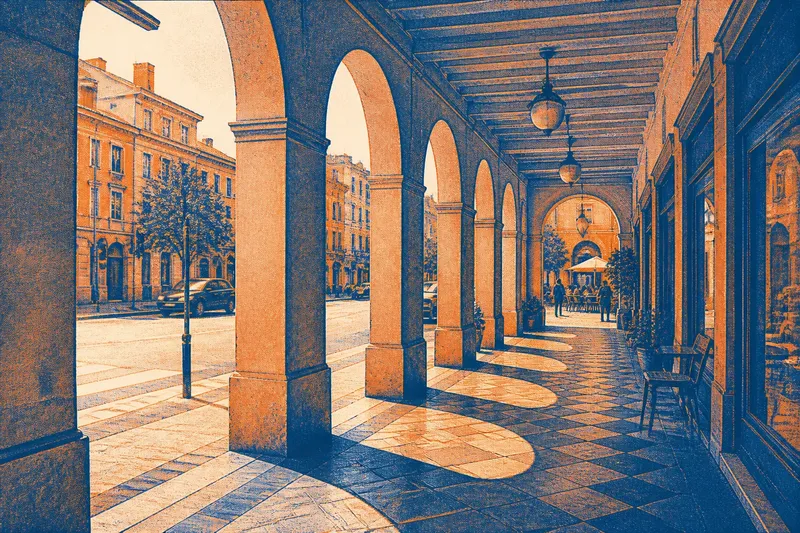
The most common mistake on an arcade walk is to treat the covered passage as a shortcut. The lost opportunity is not merely a view of the shops: it is the change in how the street sounds, feels, and unfolds when a roof shelters the route but leaves its sides open. An architectural arcade is a covered street between indoors and out, and its character lies in that incomplete separation.
That makes an arcade a useful place to slow down, without turning the walk into an architectural exam. Notice where the roof begins, how each opening frames the street beyond, and what changes as you pass between bright pavement and shaded floor. Those details can give a familiar block a distinct rhythm.
What is an arcade?
An arcade is a passage or walkway sheltered by a roof and bordered by a repeated sequence of arches or openings. Depending on the building, the openings may face directly onto a street, enclose a courtyard, or connect a public route through a larger complex. Shops often occupy the sheltered edge, but retail is not what defines the form.
The essential feature is the arrangement: a roof overhead, a route through, and a recurring edge that admits views, air, or movement from outside. A colonnade uses a line of columns to support a roof, while an arcade commonly emphasizes the openings between supports. In everyday speech, the terms can overlap; the built arrangement matters more than the label on a map.
How does an arcade differ from a covered mall?
An arcade generally keeps a more legible relationship with the street or open air. Its route may be public-facing and its edges may remain open, so a walker can sense the weather, traffic, or neighboring buildings while under cover. A covered mall usually encloses its circulation within a larger interior, with entrances that mark a clearer break from the street.
There are hybrids, and some arcades have been enclosed or altered over time. Rather than deciding by name alone, look for what the passage connects and whether its openings still expose it to the surrounding place. That tells you more about the experience than a directory description does.
Why do repeated openings matter?
Repetition makes the arcade readable as a route. A run of arches, columns, or rectangular bays gives the eye a steady sequence to follow, while small variations keep the passage from feeling mechanical. One opening may frame a side street; another may reveal a shop entrance, a tree, or the far end of the block.
As you walk, the view changes in measured increments. A column briefly interrupts the scene, then the next opening presents it again from a slightly altered position. This is a different way of seeing a street than standing at a viewpoint: the architecture parcels the view into successive glimpses.
The repeated structure also gives a useful visual reference when the passage bends or meets a courtyard. You can read its direction from the rhythm of the supports, rather than relying on a sign. It is not a substitute for a map in a complicated building, but it can make a simple route easier to understand.
What do the thresholds change?
A threshold is the point where the character of the route shifts: from exposed pavement to covered paving, from street noise to a softer acoustic space, or from a public walk to a more enclosed court. In an arcade, these transitions can be gradual. The roof may extend over the sidewalk before the passage feels fully separate, and the floor surface may change only after a few steps.
Pay attention to the sequence rather than searching for one dramatic entrance. Look up to see where the roof starts; look sideways to see whether the openings remain broad or narrow; notice whether the paving continues from the street. A shallow transition can make the arcade feel like an extension of the sidewalk, while a more defined entrance can make it feel like a room with a public route through it.
These thresholds also help explain why an arcade can feel sheltered without feeling indoors. The roof offers protection overhead, but open sides keep the surrounding street present. The boundary is real, though it is made of changes in cover and framing rather than a single enclosing wall.
How can you read an arcade on a walk?
Walk the passage once at an unhurried pace, then pause where the sequence changes. Choose a point where you can see both the covered route and an opening to the street. From there, consider:
- Where does the roof begin and end?
- Are the openings continuous, or interrupted by walls, doors, or shopfronts?
- Does the paving continue from the sidewalk, or signal a different zone?
- What can you see through the openings: traffic, a courtyard, another passage, or only a close wall?
- Does the route invite through-movement, lingering, or both?
These are observations, not a scorecard. The useful question is how the design shapes your movement and attention. A narrow arcade with frequent supports may create a close, measured passage; a broad one with long openings may keep the street in view almost continuously.
Say you arrive at a covered shopping passage with a busy road outside and a quiet courtyard at its far end. You notice that the first openings face traffic, while the last reveal trees and benches; the paving also changes near the courtyard. That sequence gives you a simple account of the route: it begins as shelter beside the street and ends as a threshold into a quieter shared space. Nothing needs to be photographed or cataloged for the change to register.
When is an arcade worth seeking out?
An arcade is especially rewarding when the surrounding streetscape changes from one edge to another. It may link a transit stop to a plaza, connect two busy streets through a courtyard, or offer a sheltered route alongside a row of active shops. In each case, its value comes from the way it holds a path close to the city while softening direct exposure to it.
It can also be a useful route in uncertain weather, but shelter is not the same as full protection. Open sides may admit wind or rain, and a passage can be closed or privately managed. For a particular site, local signs and access rules determine where visitors may go; follow the posted directions.
Not every arcade deserves a deliberate detour. If it is closed, heavily obstructed, or simply a short covered frontage with no meaningful passage, there is little benefit in forcing an architectural reading onto it. A glance from the sidewalk may be enough.
What should you notice first?
Is an arcade always open to the public?
No. Some arcades function as public routes, while others sit within privately managed buildings or close outside certain hours. Check visible signs and entrances before treating the passage as a through-route.
Can an arcade be outdoors?
Yes. A roof can shelter the walkway while open sides keep it exposed to outdoor air and street activity. The result is neither a fully enclosed room nor an uncovered sidewalk.
What is the difference between an arcade and a colonnade?
A colonnade is a row of columns supporting a roof or structure. An arcade is commonly recognized by its repeated openings, often formed by arches, though everyday usage can overlap when a colonnade creates a covered passage.
How should I photograph an arcade?
Choose a position that shows both the repeated supports and what lies beyond them, rather than filling the frame with a single arch. If people are present, leave room around the passage so the image conveys how it connects to the street.
Why does the form linger?
The architectural arcade makes a modest offer: cover overhead, a route underfoot, and repeated openings that keep the outside in view. Its passage is easy to cross quickly, but its thresholds and frames reward a slower look at how a street joins a building, a courtyard, or another street.
On your next walk, use the arcade’s openings as a sequence rather than a backdrop. The main phrase is simple enough to remember: an architectural arcade shelters movement while preserving a visual connection to its surroundings. That connection is the useful detail to carry on, even after the roof ends.