A Museum Visit Built Around One Line on the Map
A museum visit built around one line on the map turns a crowded floor plan into a calm route, with room to pause, linger, and change pace.
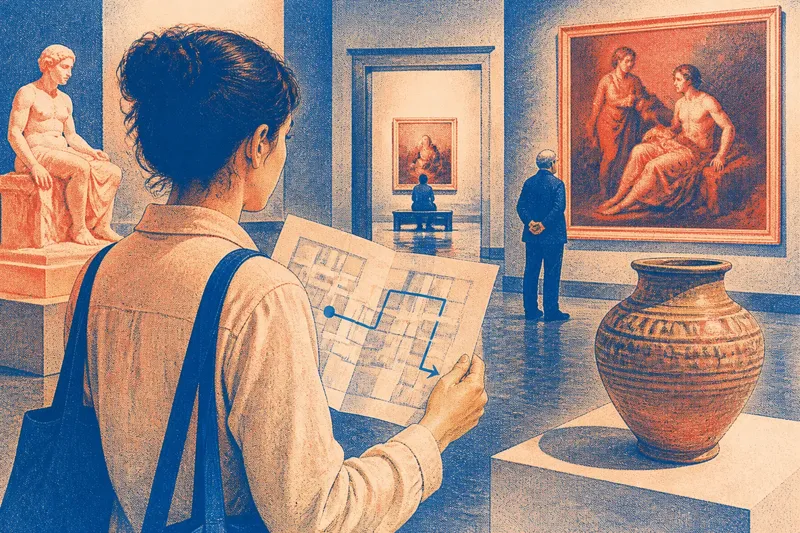
The common mistake in a museum is to treat the floor plan as a checklist, moving from room to room until attention gives out. A museum visit built around one line on the map avoids that drift: choose a route already marked on the plan, follow it at an unhurried pace, and let the rooms decide where to stop. The cost of trying to see everything is often a visit remembered chiefly as a sequence of doorways.
This is not a hunt for the shortest route or the most famous objects. One line gives the visit a modest shape without turning it into an assignment. It can be a printed trail, a colored route, or a clear corridor linking a run of galleries. The line is a guide, not a contract. If a room holds your attention, the timetable can wait.
Choose a useful line
Imagine that Mara has a free afternoon in an art museum she has never visited. The floor plan shows a blue route through several galleries, beginning near the entrance and ending beside a courtyard. She has no particular artist in mind and does not want to spend the afternoon consulting her phone. The blue line is enough of a starting point.
Before she sets off, Mara checks the plan for three practical details: where the line begins, whether it passes through the kinds of rooms she wants to see, and whether it reaches a natural stopping place. She also looks for closed galleries, temporary detours, and stairs or elevators that could affect the route. This is a brief orientation, not a study of the building’s entire anatomy.
A useful route has enough variety to hold attention, but it need not cover every wing. A line through sculpture rooms, a small courtyard, and a quieter gallery may suit a slow visit better than a route that races between popular highlights. If several lines appear, choose by the character of the rooms or the available time, rather than by the promise that one contains the most important things. Importance is difficult to enjoy at walking speed.
Mara chooses the blue line because it passes through a sequence of rooms with different arrangements and ends near a place to sit. She notes the endpoint on the plan, then folds the leaflet so the route remains visible. She does not add a second route “just in case.” That small refusal saves her from turning the afternoon into route management.
Set the first pace
At the entrance, Mara finds the line’s starting point and checks the room labels against the map. She begins by walking, not reading every object label as soon as it appears. This gives her a sense of the room’s layout: where the light falls, which objects are placed together, and where other visitors tend to gather. The first pass is allowed to be incomplete.
Then she chooses a place to pause. It is not necessarily the largest painting or the object surrounded by the most people. It is a ceramic vessel displayed near a wall, with enough space around it to look from more than one angle. She reads the short label, looks back at the vessel, and notices that its shape changes as she moves. The room has set the first stop without needing a schedule.
The useful rhythm is simple: enter, orient, notice, pause, and continue when attention begins to move elsewhere. This is not a strict sequence for every gallery. In a narrow room, Mara keeps moving until she finds clear space; in a broad one, she crosses to a bench before reading. She adjusts to the room rather than asking the room to obey the map.
Following the line slowly also means leaving gaps. Mara passes a crowded display without waiting for a clear view, knowing that the route may bring her near it again or that another object may answer the same curiosity. She does not need to defend every omission. A floor plan is a navigation aid, not a record of moral effort.
Let rooms change the plan
The line continues into a gallery of large paintings. The change in scale makes the route feel different: Mara takes a longer view from the doorway, then approaches one canvas that draws her in. She spends time with its color and the way the figures are arranged, but skips the wall text for the neighboring works. The route has brought her there; it has not required an equal share of attention for every object.
In the next room, a school group is gathered around a display case. Mara keeps to the edge, looks at a few objects from a distance, and moves on. This is a useful choice, not a failure to follow the line. If the route is blocked or a gallery is closed, she checks the printed plan or the museum’s current signs for the next accessible connection. Where the right route depends on local access rules or the museum’s instructions, follow those directions.
The most important adjustment is to distinguish a worthwhile pause from a stalled one. A pause can be quiet and brief: sitting on a bench, looking back toward an earlier room, or letting a detail settle. A stall is often the effort to force attention after it has gone. Mara leaves a gallery when she has stopped noticing anything new, rather than remaining there because the map has drawn a line through it.
It is not worth the effort to photograph every room, mark every object, or keep checking the route after each doorway. A small fold in the map or a glance at a wall sign is usually enough. The phone can stay away unless it is needed for access information, a family meeting point, or another practical purpose.
Keep the line flexible
Halfway through the route, Mara finds that one gallery has no obvious exit along the blue line. She looks at the plan again and sees that the route bends through a side passage. Rather than backtracking through every room, she asks a gallery attendant to confirm which doorway connects to it. The question takes less time than trying to reconstruct the whole building from memory.
She also notices a small room adjacent to the route, devoted to drawings. The blue line does not enter it, but the doorway is open and the room is quiet. Mara steps inside, looks at a few works, then returns to the marked path. This is the difference between a chosen detour and a second itinerary: the detour serves the visit, while the itinerary begins to compete with it.
Say you arrive late for an appointment and have less time than expected. Keep the same line, but shorten the pauses rather than trying to sprint through every room. In Mara’s invented visit, she would spend a few minutes in the galleries that hold her attention, pass through the others with a broad look, and end at the courtyard as planned. The observable result would be a visit with a clear beginning and end, not a hurried attempt to cover the whole building.
If fatigue arrives sooner than expected, the line can also become a route to an exit or a place to sit. Check where the nearest bench, cafe, restroom, and accessible exit appear on the museum’s current map. Knowing those landmarks does not turn the visit into logistics; it lets the route remain easy to abandon when the body asks for a pause.
Questions about museum routes?
What if the museum has no marked route?
Choose one visible corridor or connected run of galleries on the floor plan and trace it with a finger before starting. Use room names, a distinctive staircase, or a courtyard as landmarks, and keep the route short enough to remember without repeated phone checks.
Should I follow the line in order?
Start at its marked beginning if that is convenient, but treat the order as a navigational suggestion. A closed room, a crowd, or a compelling adjacent gallery can justify a change; the useful part is having one clear path to return to.
How long should I stay in each room?
Stay while you are noticing something: a composition, a material, a change in scale, or the way the room brings objects together. Move on when attention thins, and pause again when another room gives it a reason to return.
Can I visit with someone who prefers a different pace?
Agree on a meeting point and a rough endpoint before splitting up briefly, especially in a building with several floors. The route can make reunion easier without requiring both visitors to spend equal time at every display.
End with a clear stop
Mara reaches the courtyard and sits for a while before leaving. She has not seen every gallery, and she cannot list every object along the blue line. She can, however, remember the vessel’s changing shape, the large paintings, the quiet room of drawings, and the transition from crowded galleries to open space. The route gave these details a sequence rather than asking them to compete as a single heap.
That is the practical value of a museum visit built around one line on the map: a simple path creates room for attention without pretending to control it. Before setting out, choose a line with a clear start and finish, learn a few landmarks, and leave the pauses unassigned. At the endpoint, take a final look at the plan only if it helps you find the exit. The map has done its job when you can put it away.