Coast Path or Ridge Walk: Choosing a View That Holds Your Attention
Coast path or ridge walk: compare route bends, horizon shifts, and layered land to choose a walk whose changing views suit the way you like to look.
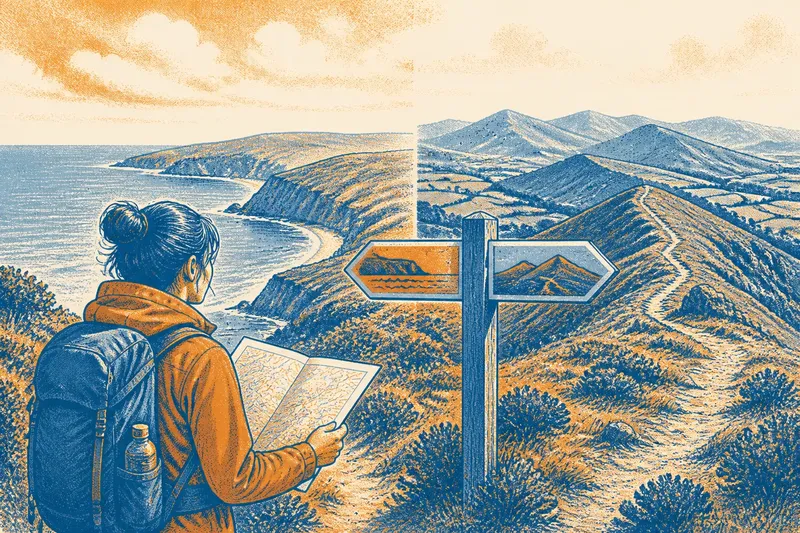
The common mistake in choosing a coast path or ridge walk is picking the grandest photograph. A view can impress at the start and stay much the same thereafter; the cost is a walk whose scenery has little of the change you hoped to follow. Choose by the route’s shape and the kind of looking you enjoy.
Choose your visual appetite
A coastal route gives attention a moving edge. Headlands overlap, bays appear from behind slopes, and the line where sea meets sky may stay level while the land slides across it. This suits you if you enjoy gradual reveals and changes in distance. The coast can offer a simple visual anchor even when the foreground is busy.
A ridge route tends to put more layers in view at once. Valleys, fields, settlements, streams, and farther ridges may share the scene. As the path bends or rises, one valley can narrow, a hill can hide a village, or a nearer slope can give way to a farther one. Choose this kind of walk if comparing landforms holds your attention more than following a single distant edge.
Neither setting is automatically more varied. A coastal path may follow an exposed shelf with little change in direction; a ridge can be narrow and enclosed by nearby rises. The route’s shape, not its label, determines what the next view might contain.
Read the route shape
Open a map with contour lines and trace the path rather than judging the destination marker. Look for bends, changes of direction, and places where the route crosses a spur or rounds a headland. These shifts can matter more to the view than a dramatic place name.
- Check for coves, projecting points, and bays on a coast path. If the route repeatedly rounds headlands, expect the shoreline’s angle to change; if it follows one long stretch, choose it for a steadier view or look for a more turning route.
- Check for saddles, side spurs, and dips behind higher ground on a ridge. If the path crosses them, expect the view to open or close in stages; if it stays on one exposed crest, choose it for a sustained panorama or seek a route with more changes in direction.
- Compare the path with the contour lines. If it follows one contour for a long stretch, expect a more consistent viewing angle; if it crosses several contours, expect the angle and visible slopes to change, or choose the steadier route if that is what you prefer.
- Look for natural openings such as a headland, ridge crest, or broad saddle. If the map places one along the route, mark it as a possible pause; if the terrain appears enclosed, plan to enjoy closer details instead of expecting a broad outlook.
- Check the route description for tree cover, buildings, and diversions. If it mentions screening or a detour, allow for interrupted views; if it gives no detail, treat the map as a clue rather than evidence that the view will be unobstructed.
- Check the forecast and local access information before setting out. If visibility or conditions make the route unsuitable for your ability, choose a more appropriate path or postpone the walk; if access is restricted, follow the land manager’s current guidance and use an open alternative.
Contour lines cannot show every obstruction. Trees, buildings, weather, and the path’s exact alignment all affect what is visible. Treat the map as a way to anticipate a sequence, not as a promise of a particular scene.
Read light and visibility
Low cloud can hide distant land from a ridge while leaving nearby textures visible; mist at the coast can soften the horizon until sea and sky nearly merge. Glare may make a coastal view harder to read, while angled light can bring folds and slopes into relief. These are possible conditions, not reliable scheduling tools.
Consider where the sun is likely to sit in relation to your direction of travel. A sea-facing route may put bright light ahead or across the water, making distant detail harder to distinguish. On a ridge, side light may reveal folds, while light from behind can leave the nearer landscape looking more even. If visibility is poor, ask whether rock, grasses, walls, or shore patterns would still hold your interest.
Check local access information and the route description before setting out. Coastal paths can include exposed sections, uneven ground, or diversions; ridge paths can have steep approaches and limited shelter. Follow local signs and choose a route suited to your ability and conditions. For current access rules, use the relevant land manager’s guidance.
Match route to attention
Say you have a free afternoon and want small changes in the view rather than a scenic backdrop. You trace a coast path that rounds two headlands with a bay between them; the route turns toward and away from the water. The likely tradeoff is clear: you get an unfolding horizon and changing shoreline, but not necessarily a broad view over several valleys. Instead, you trace a ridge path that crosses a saddle before reaching a crest. That route is likely to shift from enclosed slopes toward a wider view across land, but cloud or nearby rises could still screen the distance.
Choose the coast if you enjoy watching a fixed horizon acquire new foregrounds, or if open water and irregular shore are enough to sustain your attention. Choose the ridge if you like locating features, comparing near and far, and seeing how one slope fits into a larger pattern. If you want both, look for a route that rises above a bay or follows a ridge with a view toward the sea; do not assume every walk can offer both equally.
Questions about route choice?
Which route changes the view more?
Neither does so by default. A turning coast path may reveal successive bays, while a straight ridge traverse may keep much of the same panorama in view.
Is a ridge walk always more panoramic?
No. Nearby hills, trees, or cloud can screen higher ground. Check the route’s position relative to valleys and spurs instead of relying on the word “ridge.”
Does a coastal path always keep the sea in sight?
No. Headlands, cliffs, vegetation, and detours can hide the water for stretches. A map can suggest where the path approaches the shore, but it cannot account for every obstruction.
What should I choose in hazy weather?
Choose a route with nearby details you would still enjoy if distant views disappeared. Shore textures and changing path angles may hold interest at the coast; nearby folds and slopes may do the same on a ridge.
Leave room for the view
It is not worth trying to predict every reveal from contour lines or chasing a perfect forecast. A route description, a look at the path’s bends, and an honest preference for horizon or land layers are enough to make a considered choice.
For a coast path or ridge walk, ask which kind of view gives your attention something to follow. Choose the route whose changes you can describe before you start, and leave room for the terrain to offer a few you did not expect.